
DriftPilot
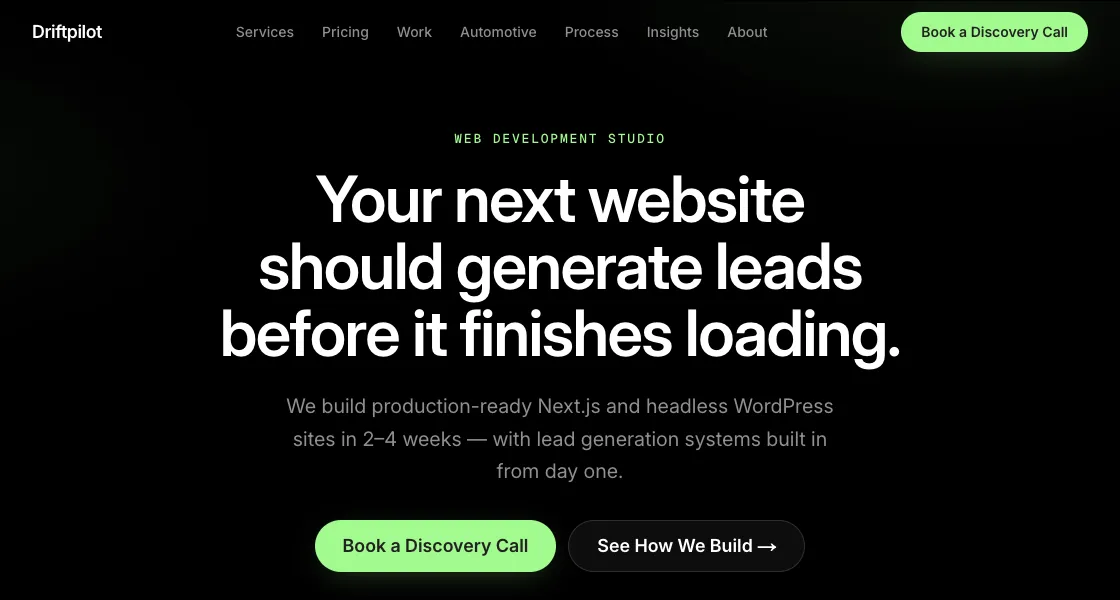
I built the studio’s site alone, from its services and pricing pages to two lead funnels, and put a performance budget on every pull request. Every one merged since has passed it.
- Period
- Jun – Jul 2026
- Role
- Sole engineer
- Live
- driftpilot.
ca - Reading
- 1 min
Overview
Everyone agrees a site should be fast, and it still gets slower, one handy dependency at a time. Reminding people in review doesn’t fix that, so I made the pipeline check it.
Every pull request on driftpilot.ca runs Lighthouse CI three times against a production build and checks the median run against the budget. A failure turns the pull request red. GitHub doesn’t stop a merge on red, but every pull request merged since the check went in has passed it.
- Pull request
- Production build
- Lighthouse × 3, median run asserted
- Red check on failure
What the gate caught
The gate caught three things review missed: a WebGL shader path that hit 39 seconds of total blocking time on software renderers, a footer colour pair below the WCAG contrast minimum, and a third-party scheduling embed that pushed the script weight over budget without anyone noticing.
I did move one budget. The original 110 kB script ceiling was never realistic once the framework and the shader measured 237 kB together, so I raised it to 260 kB on purpose and wrote down why. That’s the line I hold: a measurement can justify moving a threshold, but deleting a failing check to get a green build can’t.

The rest of the build
The site is 37 statically prerendered routes with no runtime database. Content sits behind typed async accessors, so a headless CMS could take over as the source without touching a page or component.
Leads go through Zod-validated Server Actions, then honeypot and time-to-submit spam checks, then a CRM webhook. The original build came in over 73 commits across 27 merged pull requests, and in it the webhook got one retry: if both attempts failed, the visitor still saw the thank-you page and the lead was lost. I fixed that in September. The webhook now gets up to three attempts within ten seconds. If a lead still fails, the visitor sees the failure with an email link that has their answers filled in, and the site makes one best-effort post of the lead to my Slack alerts channel. The site’s first tests cover that path and run in CI.
Stack
- Next.js 16
- React 19
- TypeScript
- Tailwind v4
- Zod 4
| Assertion | Budget | Result |
|---|---|---|
| Performance | ≥ 95 | passing |
| Accessibility | ≥ 98 | passing |
| SEO | ≥ 95 | passing |
| Best practices | ≥ 90 | passing |
| Largest contentful paint | < 1500 ms | passing |
| Cumulative layout shift | < 0.05 | passing |
| Total blocking time | < 150 ms | passing |
| Script weight | < 260 kB | 237 kB on PR #18 |
Measured
- Prerendered routesno runtime database
- 37
- Defects caughtby the gate, missed in review
- 3
- Script weightagainst a 260 kB ceiling
- 237 kB
- Merged pull requests73 commits
- 27